Imprinted Concrete Driveways in Gloucester & Gloucestershire
Decorative, Low-Maintenance Concrete Driveways Across Gloucestershire
Imprinted Concrete Driveways in Gloucester & Gloucestershire
Stylish Imprinted Concrete Driveways in Gloucester
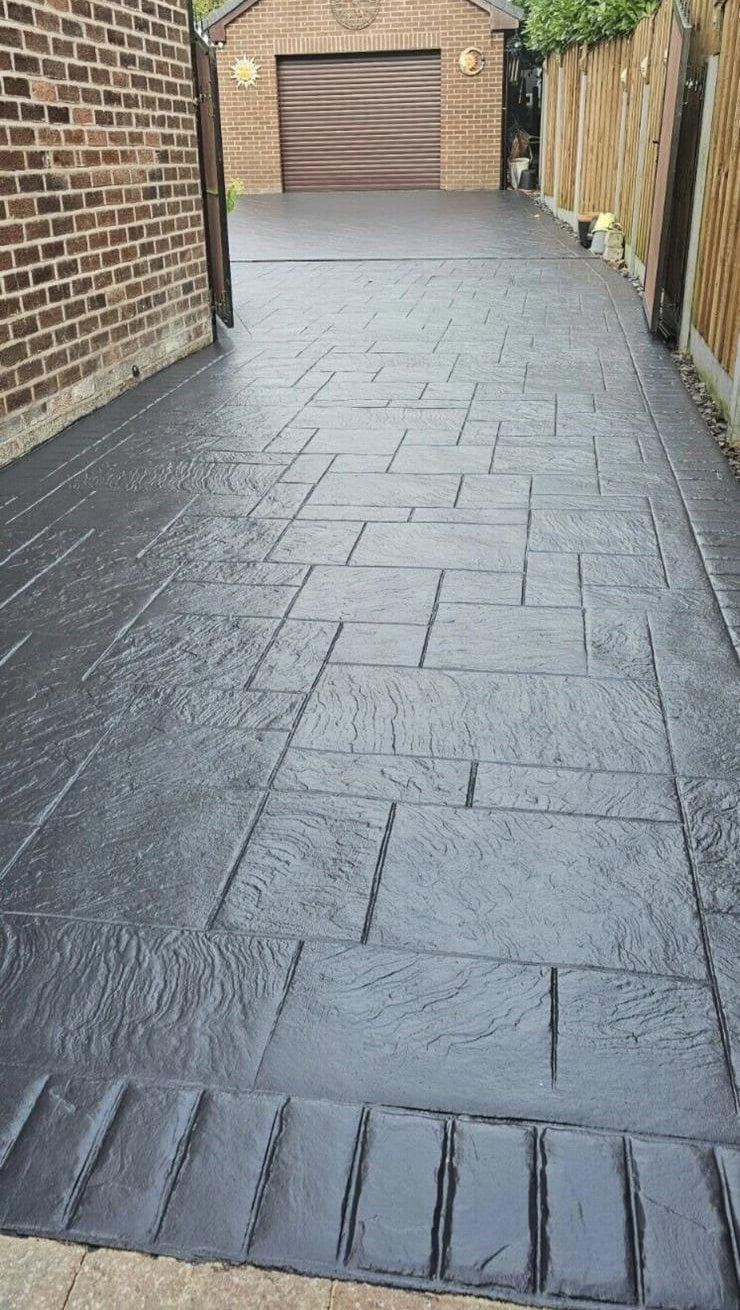
Imprinted concrete — also known as pattern imprinted concrete or stamped concrete — is one of the most popular driveway choices for homeowners who want the look of natural stone, brick, cobbles or slate without the cost and maintenance of the real thing. The entire driveway is poured as a single, continuous concrete slab, then stamped with your chosen pattern and finished with a colour hardener and protective seal while still fresh — giving you a strong, weed-free, decorative surface that stays looking sharp for years.
At SJS Landscaping & Gardening, we install pattern imprinted concrete driveways across Gloucester, Cheltenham, Stroud, Cirencester and the wider Gloucestershire area. Whether your property is a modern semi in Quedgeley, a Victorian terrace in Cheltenham, a Cotswold stone cottage near Cirencester, or a family home in Gloucester, there’s a pattern and colour combination that suits. We’ve installed imprinted concrete on straight driveways, curved layouts, sloping frontages and combined driveway-and-patio projects — every one built with proper groundwork, expansion joints and a sealed finish.
Unlike block paving (which can shift, sink and let weeds through the joints) and gravel (which can spread and needs raking), imprinted concrete gives you a solid, joint-free surface that won’t move, won’t grow weeds, and cleans up easily with a pressure washer. The trade-off is that it’s impermeable — so proper drainage needs to be factored in — and it does require resealing every 3–5 years to keep the colour and protection at their best.
Get a Free Imprinted Concrete Driveway Quotation
If you’re thinking about an imprinted concrete driveway in Gloucester or anywhere across Gloucestershire, we’d be happy to help.
Call us on 0800 656 9671, 01452 899 402 or 07593 952 715 to arrange a free, no-obligation visit.
Our Imprinted Concrete Driveway Services in Gloucester
Pattern & Colour Options
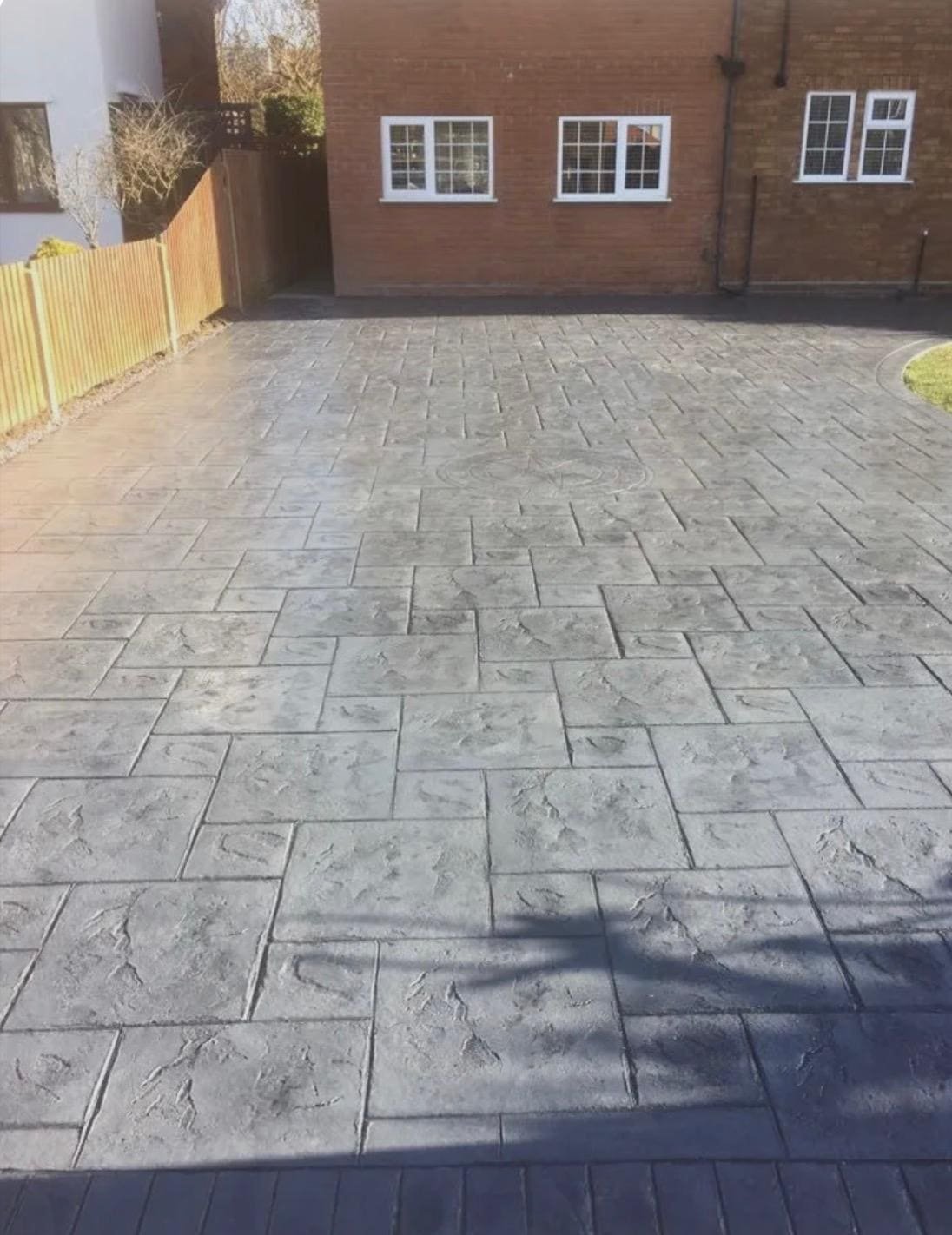
We offer a wide range of stamped patterns and colour finishes to suit every property style. Popular patterns include Ashlar Slate (clean, geometric lines — ideal for modern homes), London Cobble (traditional, characterful — suits period properties), Herringbone Brick (classic look without the maintenance of real brickwork), Random Stone (natural, organic feel for Cotswold and rural settings), and Grand Ashlar (bold, large-format for maximum visual impact). Colours range from warm buffs, sandstones and terracottas to cool greys, charcoals and slate tones. We can also add a contrasting border colour to frame the driveway and create a more finished look. We'll bring pattern and colour samples to your site visit so you can see them against your property's brickwork, stonework and surroundings.
Full Ground Preparation
Every imprinted concrete driveway starts with thorough excavation and ground preparation. We excavate the existing surface, remove all soil and old materials, and lay a compacted sub-base (typically MOT Type 1, 100–150mm deep) before the concrete is poured. On clay-heavy ground common across the Severn Vale around Gloucester, Churchdown and Tewkesbury, we pay particular attention to sub-base compaction and drainage to prevent ground movement that can cause cracking. Proper preparation is what separates a driveway that lasts 20+ years from one that cracks within a season.
Decorative Borders & Edging
A contrasting border pattern and colour around the perimeter of the driveway adds a polished, high-end look that frames the main design. We use a separate stamp and colour to create borders that complement — not match — the main driveway pattern. This is one of the details that elevates a stamped concrete driveway from good to impressive, and it's particularly effective on larger driveways where the main pattern alone can look monotonous without a defined edge.
Protective Sealing
Once the concrete has been poured, coloured, stamped and cured, we apply a high-quality acrylic sealant to the entire surface. This seal protects the colour from UV fading, prevents staining from oil, dirt and tyre marks, enhances the pattern definition, and adds a subtle sheen that lifts the overall appearance. The sealant also provides a degree of slip resistance. We recommend resealing every 3–5 years to maintain the colour vibrancy and surface protection — a straightforward maintenance task that keeps your driveway looking fresh for decades.
Repairs & Resealing
If you have an existing imprinted concrete driveway that's looking faded, worn or patchy, we can clean, repair and reseal it to restore the colour and protection. Resealing involves thorough pressure washing, allowing the surface to dry completely, and applying a fresh acrylic sealant. For driveways with minor cracks or surface damage, we can often repair these before resealing. If the original installation was poorly done and the surface is failing badly, we'll advise honestly on whether a reseal is worthwhile or whether a new installation would be a better long-term investment.
Do You Need Planning Permission for an Imprinted Concrete Driveway?
Drainage & Planning Permission
Imprinted concrete is an impermeable surface — rainwater doesn’t drain through it. Under SuDS (Sustainable Drainage Systems) regulations, you need planning permission if you’re paving over more than 5 square metres of front garden with an impermeable material unless you provide a drainage solution that keeps water within your property boundary.
In practice, this means most imprinted concrete driveways need either:
— A fall/gradient directing rainwater towards a permeable area on your property (e.g. a lawn, border or gravel soakaway), or
— A drainage channel or linear drain at the driveway’s lowest edge directing water to a soakaway crate underground, or
— A planning permission application if neither of the above is feasible.
We factor drainage into every imprinted concrete installation from the design stage — setting the correct fall gradient (typically 1:80 towards a lawn, border or drain) so surface water is managed properly without needing a separate planning application. This is standard on every job we do, and we’ll explain the drainage approach clearly during your site visit.
For comparison, gravel driveways are permeable and don’t need any drainage provision or planning permission at all — so if planning or drainage is a concern, gravel may be a simpler alternative worth considering.
Imprinted Concrete vs Other Driveway Types
How Does Imprinted Concrete Compare Vs Other Driveways?
Imprinted Concrete vs Block Paving
Both are decorative, but imprinted concrete is typically faster to install (poured as one slab vs laying individual blocks), weed-free (no joints for weeds to grow through), and often more affordable. Block paving is easier to repair in sections and is inherently more flexible on ground that moves. Choose imprinted concrete for a seamless, weed-free finish; block paving if you prefer individual-block aesthetics and easy spot repairs.
Imprinted Concrete vs Tarmac
Tarmac is cheaper and quicker to install, but offers no decorative appeal — it's a plain black surface. Imprinted concrete gives you the look of stone, brick or slate for a modest premium over tarmac, making it a much more visually impactful option.
Imprinted Concrete vs Gravel
Gravel is the cheapest option and naturally permeable (no planning concerns), but it shifts, needs raking and doesn't suit every property. Imprinted concrete provides a solid, permanent, decorative finish — better for kerb appeal and formal frontages.
Imprinted Concrete vs Resin
Resin-bound driveways offer a smooth, modern finish and are permeable. Imprinted concrete offers more dramatic pattern options (you can replicate cobbles, slate, brick) and is generally more affordable. Resin is better for a sleek, contemporary look; imprinted concrete is better for character and traditional patterns.
Not sure which is right? We install all five driveway types and can advise during a free site visit.
Why Choose Imprinted Concrete?
Premium Pattern-Imprinted Concrete for Homes in Gloucester
Attractive, High-End Finish
Imprinted concrete gives you the look of natural stone, brick, cobble or slate — at a fraction of the cost and without the ongoing jointing and levelling maintenance. The range of patterns and colours means you can match the driveway to any property style, from contemporary builds in Gloucester to Cotswold stone cottages near Cirencester and Victorian frontages in Cheltenham.
Weed-Free & Low Maintenance
Because the entire driveway is a single concrete slab, there are no joints, gaps or seams for weeds to grow through — unlike block paving which typically needs regular re-sanding and weed treatment. The only maintenance required is periodic resealing (every 3–5 years) and an occasional pressure wash to keep the surface looking fresh.
Strong & Durable
Reinforced with steel mesh and poured to a minimum 100mm depth, imprinted concrete is built to handle daily car use, delivery vehicles and changing weather conditions. A well-installed, properly maintained imprinted concrete driveway can last 20–25 years or more.
Customisable Designs
With dozens of stamp patterns, a wide palette of colours, and the option of contrasting borders, every imprinted concrete driveway is unique to the property. You choose the combination during your site visit — and because the stamping is done by hand, irregular shapes, curves and split-level designs are all achievable.
Cost-Effective Alternative to Stone
Natural stone paving, real cobblestones and handmade brick driveways are beautiful but expensive. Imprinted concrete replicates their appearance convincingly at a significantly lower cost — typically £80–£100 per square metre fully installed compared to £100–£150+ for genuine stone or block paving. For homeowners who want a premium appearance without the premium price, imprinted concrete is one of the best options available.
How We Install an Imprinted Concrete Driveway
Imprinted concrete is a specialist process — the entire pour, colouring and stamping must be completed before the concrete cures. Here’s how we do it:
Site Visit, Design & Quote
We measure your driveway, discuss pattern and colour options, assess ground conditions, drainage requirements and access, and provide a clear, itemised quote.
Excavation & Sub-Base
The existing surface is excavated to a depth of 200–250mm. A compacted MOT Type 1 sub-base (minimum 100–150mm) is laid and levelled. Formwork (temporary timber edging) is set to define the driveway shape and hold the concrete during pouring.
Steel Reinforcement
Steel mesh reinforcement (typically A142 or A193) is laid on top of the sub-base. This reinforcement is critical — it holds the concrete slab together and significantly reduces the risk of cracking from ground movement, thermal expansion and vehicle loads.
Concrete Pour
Ready-mixed concrete is poured to a minimum depth of 100–125mm for domestic vehicle use (thicker for heavy vehicle areas). The surface is levelled, tamped and floated smooth.
Colour Hardener
While the concrete is still fresh, a colour hardener powder is broadcast across the surface. This pigmented powder bonds with the top layer of concrete, creating a dense, hard-wearing coloured surface that resists fading and wear.
Pattern Stamping
Before the concrete fully sets, specialist pattern mats are pressed into the surface to create the chosen design — cobblestone, ashlar slate, herringbone brick, random stone, or any other pattern. A release agent is applied first to prevent the mats from sticking. Borders and edging are stamped separately using different mats and often a contrasting colour. Timing is critical at this stage — the concrete must be firm enough to hold the imprint but soft enough to accept the pattern. This is where experience and skill make all the difference.
Expansion Joints
Control joints are cut into the surface at strategic intervals. These planned joints direct any natural concrete movement into controlled lines rather than random cracks — significantly reducing the risk of visible cracking over the driveway's lifetime.
Washing & Sealing
After curing (typically 24–48 hours), the surface is washed to remove the release agent and reveal the full colour and pattern definition. A high-quality acrylic sealant is then applied to protect the colour, enhance the finish and provide slip resistance.
Curing & Handover
The driveway is walkable within a few hours but should not be driven on for at least 48–72 hours to allow full curing. We advise waiting 7 days before regular vehicle use. All waste is removed and the site left clean.

Get a Free Imprinted Concrete Driveway Quote in Gloucestershire
Whether you want a new imprinted concrete driveway, a patio or path in pattern concrete, or resealing and maintenance on an existing stamped surface, we’d be happy to help. We cover Gloucester, Cheltenham, Stroud, Cirencester and all surrounding areas.
Freephone
Office
Mobile
All information shared with SJS Landscaping & Gardening is kept safe and secure.
Imprinted Concrete Driveways Across Gloucester & Gloucestershire
We install pattern imprinted concrete driveways across the county — from modern suburban homes in Gloucester and Quedgeley to period properties in Cheltenham, rural cottages around Cirencester, and hillside driveways across the Stroud valleys. Whatever your property style, there's a pattern and colour to match.
- Gloucester
- Cheltenham
- Stroud
- Cirencester
- Tewkesbury
- Dursley
- Cinderford
- Cam
- Churchdown
- Stonehouse
- Quedgeley
- Bishops Cleeve
- Winchcombe
- Nailsworth
- Coleford
- Brockworth
- Longlevens
- Abbeydale
Imprinted Concrete Driveways FAQs
If you’ve got questions about our services, the process or what to expect, the FAQs below should help – and if you need anything else, just give us a call.
A typical single or double driveway takes 3–5 days to complete, including excavation, sub-base, concrete pour, stamping, curing, washing and sealing. Larger or more complex designs may take 5–7 days. Weather is a factor — the concrete pour and stamping stages need dry conditions, so we schedule accordingly and keep you informed if adjustments are needed.
The colour hardener used during installation is bonded into the concrete surface, so it won't wash away. However, the protective acrylic sealant on top does wear over time — typically after 3–5 years. When the sealant fades, the colour can look duller. Resealing restores the vibrancy and protection. With regular resealing on schedule, the colour should stay strong for the lifetime of the driveway.
No — the stamped pattern creates a textured surface with natural grip, and the sealant we apply includes anti-slip properties. Imprinted concrete is generally no more slippery than other hard surfaces like block paving or flagstones when wet. The textured imprint pattern actually provides better grip than a smooth concrete surface.
All concrete can develop minor hairline cracks over time — this is a natural characteristic of the material. However, the risk of significant cracking is greatly reduced by proper ground preparation, a compacted sub-base, steel mesh reinforcement, adequate concrete depth (minimum 100mm), and strategically placed expansion/control joints. These planned joints direct any natural movement into controlled lines rather than random cracks. On clay-heavy ground around Gloucester and the Severn Vale, sub-base quality is especially important to prevent ground movement causing stress cracks.
Call us on 0800 656 9671, 01452 899 402 or 07593 952 715, or fill out the form on this page. We'll arrange a free site visit, discuss pattern and colour options, assess ground conditions, and provide a clear, itemised quote. All quotes are free with no obligation.
A fully installed imprinted concrete driveway typically costs between £80 and £100 per square metre in Gloucestershire, including excavation, sub-base, reinforcement, concrete, colour, pattern, sealing, drainage and waste removal. A standard single-car driveway of around 30–40sqm costs roughly £2,400–£4,000 depending on size, pattern complexity and ground conditions. We provide itemised quotes after a free site visit.
We recommend resealing every 3–5 years to maintain colour vibrancy, surface protection and slip resistance. Resealing is a straightforward process — the driveway is pressure washed, allowed to dry, and a fresh coat of acrylic sealant is applied. It's the main ongoing maintenance cost for imprinted concrete and keeps the driveway looking fresh for decades.
The surface is walkable within a few hours. Light foot traffic is fine after 24 hours. We recommend waiting at least 48–72 hours before driving on it, and ideally 7 days for full cure strength before regular vehicle use. We'll give you clear guidance on curing times when the work is completed.
Imprinted concrete is impermeable, so if your driveway covers more than 5 square metres of front garden, you either need to direct rainwater to a permeable area on your property (lawn, border, soakaway) or apply for planning permission. We design every installation with proper drainage falls so this is handled as part of the job — in most cases, no separate planning application is needed because we direct water to a lawn, border or drainage channel.
We offer a wide range of stamp patterns including Ashlar Slate, London Cobble, Herringbone Brick, Random Stone, Grand Ashlar, Timber Plank, and many more. Each pattern is available in dozens of colour combinations. We bring pattern boards and colour samples to your site visit so you can see and compare against your property before deciding.
Yes — imprinted concrete works equally well for patios, garden paths and walkways. Many of our clients choose matching imprinted concrete for both the driveway and patio to create a cohesive, unified look across the front and rear of the property.
The acrylic sealant provides a protective barrier that resists most stains, including oil and tyre marks, especially when the seal is fresh. Any spills should be cleaned up promptly with warm soapy water. Over time, as the sealant wears, the surface becomes slightly more porous — which is why regular resealing is important. If a stain does occur on an older surface, a good pressure wash before resealing usually removes it.
The concrete pour and stamping stages need dry conditions and temperatures above 3°C — concrete doesn't cure properly in freezing conditions. We schedule installations accordingly, typically between March and November in Gloucestershire. If unexpected rain is forecast during a booked job, we'll communicate with you and reschedule the pour rather than risk a compromised finish.